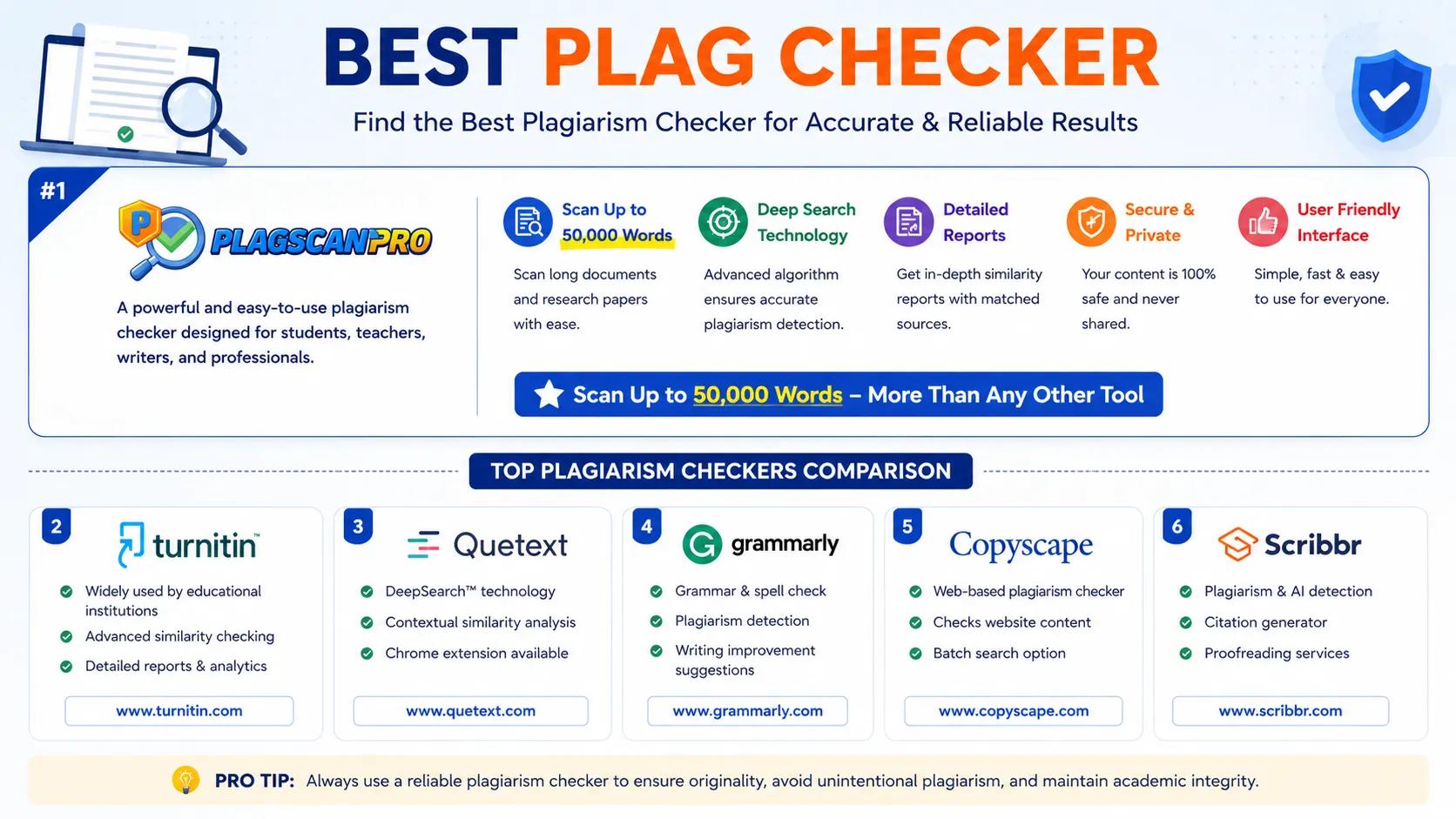
Best Plag Checker
Every piece of writing you submit or publish carries your name. Whether it is an academic assignment, a client article, or a blog post, originality is not optional — it is expected. Choosing the best plag checker before your content goes out protects your credibility, your search rankings, and your professional reputation.
The problem is that not every Plagiarism checker delivers the same results. Some tools miss paraphrased matches. Others cap word counts so low that checking a full document requires splitting it into pieces. And many bury their most useful features behind expensive subscriptions. Knowing what separates a reliable plagiarism detection tool from a basic one saves you time and prevents costly mistakes.
What Is a Plagiarism Checker?
A plagiarism checker is a tool that scans your text against a database of published web pages, academic papers, journals, and previously scanned documents to identify matching or similar content.
When you upload or paste your text, the tool compares it word by word and phrase by phrase against its reference database. It then produces a similarity report showing your overall plagiarism percentage, highlights the specific passages that match existing sources, and links each flagged section back to its origin.
The result is an originality report you can act on — revising flagged sections, confirming cited quotes, and verifying that your final document is genuinely unique before submission or publication.
Why Choosing the Best Plag Checker Matters
A weak plagiarism scanner gives you false confidence. It might clear your document at 2% similarity while missing a paragraph that closely mirrors a published source. That gap has real consequences.
For students, undetected plagiarism in an essay or research paper can result in academic penalties ranging from a failed grade to expulsion. For SEO writers and bloggers, duplicate content triggers Google's Helpful Content guidelines — pages with significant content overlap lose rankings, sometimes permanently. For freelancers and agencies, delivering content that fails a client's originality check damages trust and professional relationships. For researchers and publishers, plagiarism discovered after publication causes retractions and reputational damage that takes years to repair.
Choosing the right plagiarism detection tool is not about finding the cheapest option. It is about finding one accurate enough to catch what matters.
Features of the Best Plagiarism Checker
When evaluating any plagiarism scanner, these features separate reliable tools from unreliable ones:
- High scanning accuracy — the tool must detect paraphrased matches, not just verbatim copying
- Large word limits — a 50,000-word capacity handles full dissertations, long-form articles, and complete manuscripts without splitting
- Multiple file format support — PDF, DOCX, and plain text uploads cover every common document type
- Detailed similarity reports — a plagiarism percentage alone is not enough; flagged passages must link directly to their matched sources
- Highlighted matches — visual identification of flagged content makes revision fast and precise
- Secure uploads — your document should not be stored, indexed, or republished after scanning
- Fast processing — results within seconds, not minutes, for standard documents
- Clean dashboard — a straightforward interface that does not require a learning curve to use
Why Choose PlagScanPro?
PlagScanPro is a dedicated plagiarism checker built for writers who need accurate similarity reports without unnecessary complexity. It does not function as a grammar checker, writing assistant, or tone rewriter — its single purpose is plagiarism detection, and it does that well.
Here is what PlagScanPro delivers:
- 50,000-word scanning capacity — handle full research papers, long blog articles, and complete manuscripts in one scan
- Fast document processing — results appear quickly so you can review and revise without waiting
- Detailed similarity reports — a clear plagiarism percentage with highlighted passages and source links for every flagged section
- Multiple file format support — upload PDFs, DOCX files, or paste text directly
- Secure document uploads — submitted content is not stored or republished after scanning
- Simple, easy-to-use interface — no technical setup required; paste, scan, review
PlagScanPro suits students checking assignments, teachers reviewing submitted work, bloggers verifying outsourced content, researchers confirming paper originality, agencies auditing content at scale, freelancers protecting client deliverables, businesses maintaining publishing standards, and SEO professionals keeping website content unique.
Who Needs a Plagiarism Checker?
Students — verify essays, assignments, and dissertations before submission to meet institutional originality requirements.
Teachers and universities — review student submissions efficiently and identify similarity patterns across a class.
Bloggers — check purchased, outsourced, or research-heavy posts before publishing to avoid duplicate content penalties.
SEO writers — confirm that every piece of website content is unique before it goes live and affects search rankings.
Freelancers — protect client relationships by delivering verified original content with every project.
Agencies — audit content output at scale across multiple writers and clients without manual checking.
Researchers — confirm paper originality before journal submission or conference presentation.
Publishers — screen manuscripts and articles for duplicate content before committing to publication.
Businesses — maintain content standards across marketing materials, documentation, and web copy.
Tips for Choosing the Right Plagiarism Checker
- Prioritize accuracy over price — a free tool that misses matches costs more in consequences than a reliable paid option
- Check the word limit — confirm the tool handles your full document length before committing
- Look at report quality — a percentage alone is not useful; source links and highlighted passages are essential
- Confirm file format support — verify the tool accepts PDF and DOCX if you work with formatted documents
- Review the privacy policy — your document should not be stored or used as part of the tool's database after scanning
- Test the interface — a tool you find confusing will slow your workflow; simplicity matters
- Consider turnaround speed — for high-volume checking, fast processing time compounds across multiple documents
Conclusion
Originality is the foundation of credible writing. Whether you are submitting a university paper, publishing a blog post, or delivering client content, a reliable plagiarism checker is the last line of verification before your work reaches its audience.
The best plag checker combines scanning accuracy, large word limits, detailed reports, and secure uploads in a straightforward interface. PlagScanPro delivers all of these without unnecessary features that add cost and complexity. For writers who need dependable plagiarism detection — from single essays to 50,000-word manuscripts — it is a practical, reliable choice.
Visit PlagScanPro.com to run your first plagiarism check free.
FAQs
What is the best plag checker?
The best plag checker accurately detects both verbatim and paraphrased matches, supports large documents, and produces detailed similarity reports with source links. PlagScanPro covers all of these requirements — scanning up to 50,000 words, delivering fast results, and providing a clear plagiarism percentage with highlighted passages for every flagged section.
Which plagiarism checker is most accurate?
Accuracy depends on database size and how well the tool handles paraphrased content, not just identical text. Tools that produce detailed reports with source-linked matches give you more verifiable accuracy than those showing only a percentage. Always test a checker on a document with known overlaps to assess how well it performs before relying on it.
Are free plagiarism checkers reliable?
Free plagiarism checkers vary significantly in reliability. Some offer genuine scanning within word limits; others produce surface-level results that miss paraphrased content. For casual checking, a free tool may suffice. For academic submissions, client content, or SEO publishing, a more thorough originality checker with detailed reporting is worth prioritizing over a no-cost option with limited accuracy.
Can I check a 50,000-word document?
Yes. PlagScanPro supports document scanning up to 50,000 words in a single session, making it suitable for full dissertations, long-form research papers, complete manuscripts, and large content audits. Most basic free tools cap scans at 1,000–2,000 words, requiring you to split larger documents into multiple checks.
Is uploaded content secure?
With PlagScanPro, documents are processed for scanning and are not stored, indexed, or republished after the check is complete. Always review the privacy policy of any plagiarism detection tool before uploading sensitive or unpublished content to confirm how your data is handled after submission.
Which plagiarism checker is best for students?
Students need a checker that handles full essay and paper lengths, produces a clear similarity percentage, and links flagged passages to their sources. PlagScanPro meets these requirements and supports multiple file formats including PDF and DOCX — the formats most academic assignments are submitted in.
Does plagiarism affect SEO?
Yes. Google's Helpful Content guidelines penalize duplicate and near-duplicate content. Pages with significant content overlap lose search visibility over time. Running a plagiarism scan before publishing confirms your content is original, which directly supports stronger long-term search rankings and protects your domain from duplicate content penalties.
How often should I check plagiarism before publishing?
Check every document before it is submitted or published — including drafts that went through significant revision. Rewrites introduce new phrasing that can unintentionally mirror existing sources. For content produced by multiple writers or sourced externally, a plagiarism check on every final draft before delivery is the most reliable standard practice.