Introduction
Plagiarism is one of the most serious mistakes you can make as a student, writer, or content creator. It can cost you your academic degree, damage your professional reputation, and hurt your search rankings.
Knowing how to avoid plagiarism is no longer optional, it is a core skill for anyone who creates written content. Whether you are writing a research paper, a blog post, or website copy, originality must always come first.
Tools like PlagScanPro make it easier to detect and prevent plagiarism before it causes real harm. In this guide, you will learn practical strategies to keep your content original every single time.
Quick Answer: How Do You Avoid Plagiarism?
To avoid plagiarism, always write in your own words, cite every source you reference, use proper paraphrasing techniques, and run your content through a reliable plagiarism checker before submitting or publishing. PlagScanPro helps you detect duplicate content, AI generated similarities, and improper paraphrasing, giving you a clear originality report before you go live.
What Is Plagiarism and Why Does It Matter?
Plagiarism means using someone else's words, ideas, or work without giving them proper credit. It is not always intentional, many students and writers plagiarize accidentally by forgetting to cite sources or paraphrasing too closely.
Plagiarism matters because:
It violates academic integrity policies and can lead to expulsion
It breaks copyright laws and can result in legal consequences
It destroys professional credibility and trust
It causes Google to penalize websites with duplicate content
It undermines the value of original research and creative work
Understanding the types of plagiarism is the first step toward learning how to avoid plagiarism effectively.
How to Avoid Plagiarism in Academic Writing
Students and researchers face the highest risk of plagiarism. Here is how to avoid plagiarism in academic settings:
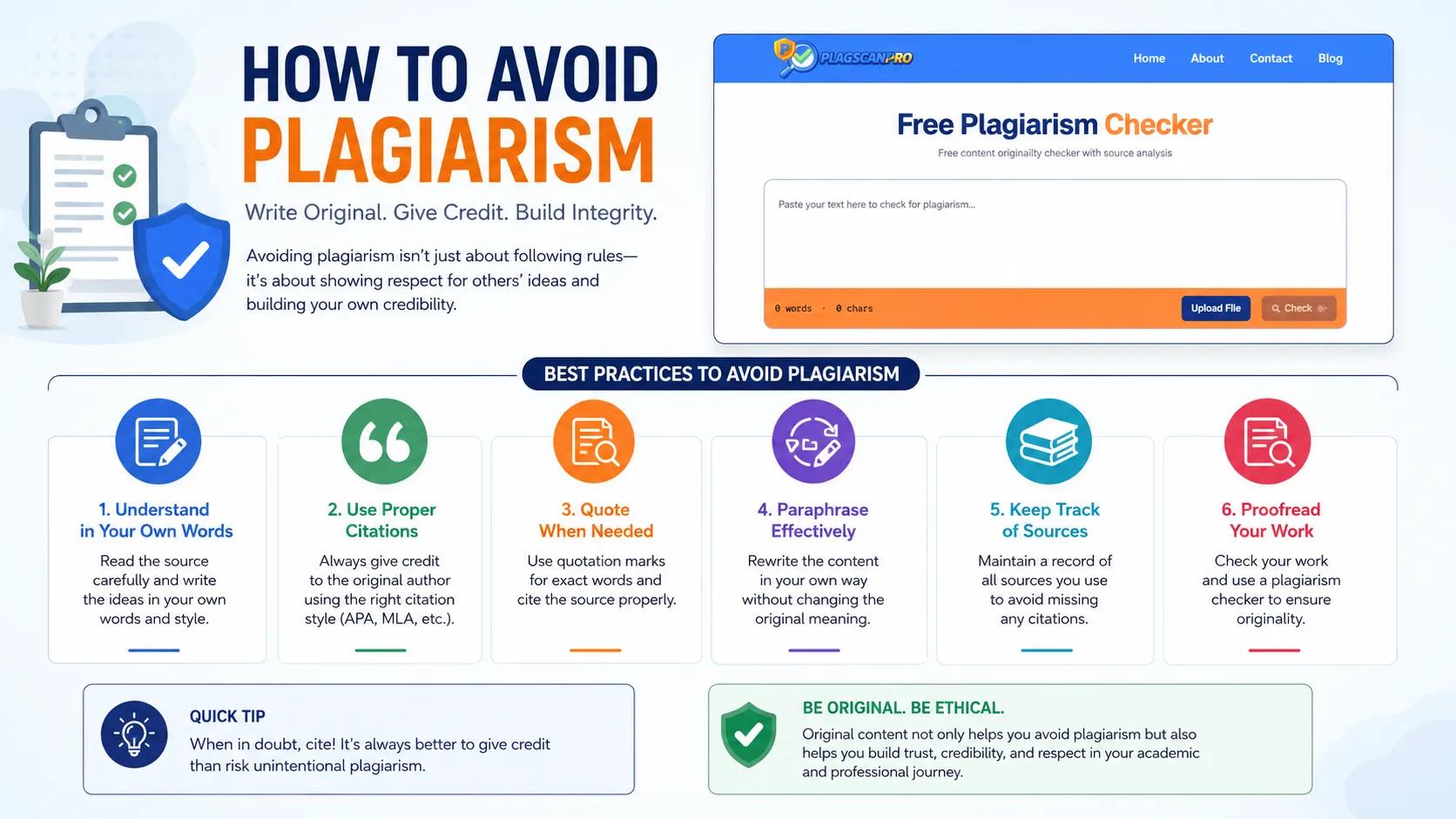
Always cite your sources, use the correct citation format for your field, whether APA, MLA, Chicago, or Harvard
Take careful notes, write down the source details every time you read or research something
Paraphrase properly, rewrite ideas in your own words and sentence structure, then cite the original author
Use quotation marks, when you use someone's exact words, place them in quotes and add a citation
Avoid self plagiarism, do not resubmit your own previous work without permission and proper disclosure
Run a plagiarism check, always scan your paper with a tool like PlagScanPro before submitting
Practical Example: A PhD student paraphrases three paragraphs from a journal article but forgets to add citations. Even though the words are different, the ideas are borrowed, making it plagiarism. Running PlagScanPro before submission would flag these sections and prompt the student to add proper references.
How to Avoid Plagiarism in Blog and Web Content
Bloggers and content writers also need to know how to avoid plagiarism. Digital content is indexed quickly and duplicate text is easy to detect.
Write all content from scratch using your own research and perspective
If you reference a statistic or fact, link back to the original source
Do not copy and paste content from other websites, even with minor edits
Use AI writing tools carefully, always verify AI generated content with a plagiarism checker
Check your content with PlagScanPro before scheduling it for publication
Conduct regular content audits to find and fix duplicate pages on your website
Google's helpful content guidelines reward original, expert written content and penalize pages that closely mirror existing web content.
How to Avoid Plagiarism With Proper Citation
Proper source attribution is the most powerful tool for avoiding plagiarism. Follow these rules:
In text citations, mention the author and year of publication within your text whenever you reference an idea
Reference lists, include a full bibliography or reference list at the end of every academic paper
Footnotes and endnotes, use these for additional source details in formal writing
Hyperlinks in web content, link directly to the source when referencing statistics or quotes online
Quotation vs. paraphrase, know when to quote directly and when to rewrite in your own words
The referencing style you use depends on your field. Academic disciplines have their own standards, always check your institution's or publication's guidelines before writing.
How to Avoid Plagiarism Using PlagScanPro
PlagScanPro is one of the most effective tools available for helping you avoid plagiarism. Here is how it works:
Upload your document, supports all major formats including .docx, .pdf, and plain text
PlagScanPro scans up to 50,000 words against billions of web pages and academic sources
It detects exact matches, paraphrased content, and AI generated text similarities
A detailed originality report shows every flagged section with a link to the matching source
You can then rewrite or cite the flagged content before submitting or publishing
Use Case: Student: A student uploads a 5,000 word thesis chapter. PlagScanPro flags two sections where paraphrasing is too close to the original source. The student rewrites those sections and adds proper citations, avoiding a plagiarism violation entirely.
Use Case: Content Agency: An SEO agency runs every client article through PlagScanPro before delivery. The tool catches one article where a freelance writer copied two paragraphs from a competitor site. The agency rewrites the content and delivers a 100% original piece to the client.
How to Avoid Plagiarism With AI Generated Content
AI writing tools are now widely used by students, bloggers, and businesses. However, AI content carries its own plagiarism risks:
AI tools can generate text that closely mirrors existing web content
Multiple users asking the same prompt may receive near identical outputs
Some AI generated text paraphrases published sources too closely without attribution
Submitting AI content as your own work in academic settings is considered plagiarism
To avoid plagiarism when using AI tools:
Always run AI generated content through PlagScanPro before using it
Rewrite AI output in your own voice before publishing
Add original insights, examples, and data that the AI did not provide
In academic settings, check your institution's policy on AI content before using it
Best Practices to Avoid Plagiarism Every Time
Follow these practical habits to make originality a standard part of your workflow:
Always write first, then research, this prevents accidental copying while reading
Keep a source log while researching, note every reference as you go
Use plagiarism detection as a final quality check, not a last minute panic fix
Paraphrase meaningfully, change the structure and wording, not just a few words
Understand the difference between common knowledge and citable information
Educate your team or students on plagiarism policies and consequences
Make PlagScanPro part of your standard content checklist
Frequently Asked Questions
1: How do you avoid plagiarism in academic writing?
To avoid plagiarism in academic writing, always cite your sources using the correct format, paraphrase ideas in your own words, use quotation marks for direct quotes, and run your paper through a plagiarism checker like PlagScanPro before submission. Keeping detailed research notes also helps prevent accidental plagiarism.
2: What is the best way to avoid plagiarism in content writing?
The best way to avoid plagiarism in content writing is to write original content, attribute all external sources with hyperlinks, verify AI generated text with a detection tool, and conduct regular site audits to catch duplicate pages. PlagScanPro makes this process fast and reliable for individual writers and content teams alike.
3: Can paraphrasing still count as plagiarism?
Yes. If you rewrite someone else's ideas too closely, keeping the same sentence structure or swapping only a few words, it is still considered plagiarism. Proper paraphrasing requires fully restructuring the idea in your own voice and adding a citation to the original source.
4: How does PlagScanPro help avoid plagiarism?
PlagScanPro scans your content against billions of web pages and academic databases, detects exact matches and paraphrased similarities, flags AI generated content, and provides a detailed report with source links. This gives you a clear list of sections to rewrite or cite before you publish or submit your work.
5: How do I avoid self plagiarism?
To avoid self plagiarism, always disclose when you are reusing or updating your own previous work. In academic writing, get permission from your institution before resubmitting past papers. In content writing, use canonical tags on duplicate pages and update old articles with new information rather than republishing them as new content.
Expert Insights on Avoiding Plagiarism
Plagiarism prevention is not just about avoiding punishment, it is about building credibility. Writers and researchers who consistently produce original work earn lasting trust from their audiences and institutions.
Google's ranking algorithms treat duplicate content as a quality signal. Websites that publish original, well cited content consistently outperform those that rely on copied or paraphrased material.
The rise of AI writing tools has made plagiarism detection more important than ever. Even unintentionally similar AI output can trigger academic or SEO penalties, making a reliable checker an essential part of any content workflow.
Knowing how to avoid plagiarism is a professional skill. Students who develop strong citation habits early carry those standards into their careers, producing more trustworthy research and more credible professional writing throughout their lives.
Conclusion
Learning how to avoid plagiarism protects your academic standing, your professional reputation, and your search rankings. Whether you are a student, a researcher, a blogger, or an SEO professional, original content is the foundation of everything you publish.
Use proper citation, paraphrase thoughtfully, understand the risks of AI content, and always run a final check before submitting or publishing. PlagScanPro makes it easy to avoid plagiarism with fast, accurate scanning and detailed reports.
Visit plagscanpro today and make content originality a standard part of your workflow.
Learn how to keep your content original by reading our guide on How to Avoid Plagiarism.